Vedic Astrology Gemstones: Planets, Fingers and Metals
A clear guide to Vedic astrology gemstones: the nine stones and their planets, which finger and metal to use, when a stone should not be worn, and the colour spectrum behind them.

Vedic astrology gemstones are among the most popular remedies in Jyotish, and also among the most misused. The idea is straightforward: each of the nine planets is linked to a specific gem, and wearing that gem in the right metal, on the right finger, is believed to strengthen the planet's positive influence. The catch is that a gemstone amplifies whatever the planet already does in your chart, for good or ill, which is why the choice must fit the individual horoscope rather than a birth month or a favourite colour.
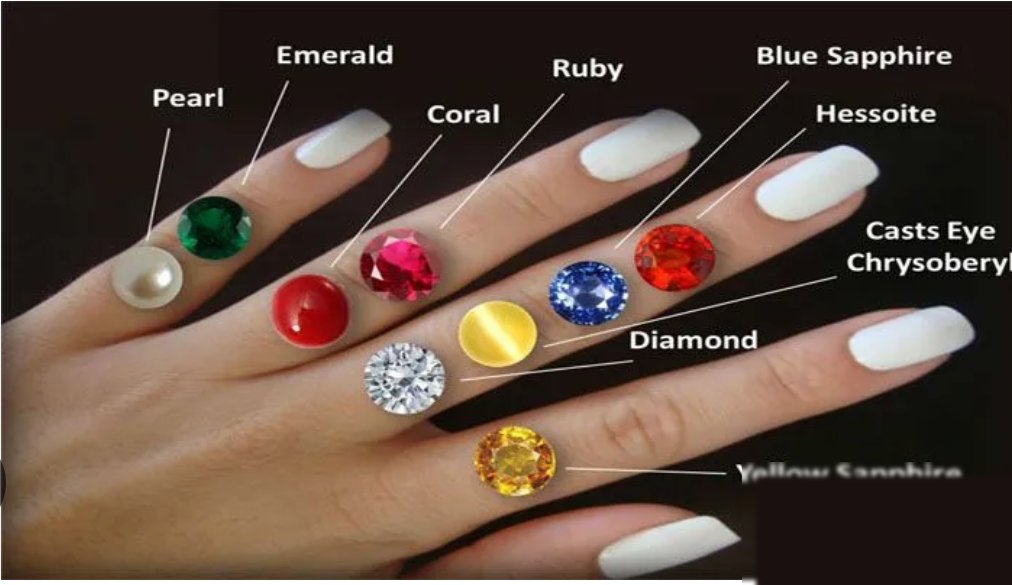
The nine gemstones and their planets
The nine stones together form the navaratna (nine gems), and each maps to one graha:
| Gemstone | Planet | Sanskrit name |
|---|---|---|
| Ruby | Sun (Surya) | Manik |
| Pearl | Moon (Chandra) | Moti |
| Red Coral | Mars (Mangal) | Moonga |
| Emerald | Mercury (Budha) | Panna |
| Yellow Sapphire | Jupiter (Guru) | Pukhraj |
| Diamond | Venus (Shukra) | Heera |
| Blue Sapphire | Saturn (Shani) | Neelam |
| Hessonite | Rahu (north node) | Gomed |
| Cat's Eye | Ketu (south node) | Lehsunia |
Which finger, which metal
Each finger is associated with a set of qualities, and each metal carries a planetary temperament. The traditional pairings line up the finger and metal with the gem's planet.
- Index finger: leadership, confidence and ambition, the finger of Jupiter, favoured for Yellow Sapphire.
- Middle finger: career, discipline and authority, the finger of Saturn, favoured for Blue Sapphire.
- Ring finger: creativity, vitality and relationships, favoured for Ruby, Red Coral and Diamond.
- Little finger: communication and intellect, the finger of Mercury, favoured for Emerald.
The metals matter too. Gold enhances the warm, expansive planets (Ruby, Yellow Sapphire); silver suits the cool, calming Moon (Pearl); platinum and white gold suit Venus and Saturn (Diamond, Blue Sapphire); copper carries the vitality of Mars (Red Coral); and panchdhatu, an alloy of five metals, is used to balance mixed energies. The general guidance is to let the stone touch the skin through an open-backed setting, so many wearers prefer that to a closed mount.
When a gemstone should not be worn
This is the step most casual guides skip, and it is the most important. Because a gemstone strengthens its planet, you do not want to strengthen a planet that mainly causes trouble in your chart. As a rule of thumb, a stone is generally avoided if its planet rules the difficult houses, the 6th (conflict and debt), 8th (upheaval) or 12th (loss), or if it rules the badhaka (obstruction) house.
The badhaka house depends on your rising sign (lagna):
- Movable signs rising (Aries, Cancer, Libra, Capricorn): the 11th house is the badhaka.
- Fixed signs rising (Taurus, Leo, Scorpio, Aquarius): the 9th house is the badhaka.
- Dual signs rising (Gemini, Virgo, Sagittarius, Pisces): the 7th house is the badhaka.
This is exactly why a gem should be chosen from the whole chart and not from a shop counter. To see which houses your planets rule before considering any stone, start with a free birth chart, and ideally confirm the choice with a practitioner through a guided reading.
The colour spectrum behind the gems
There is an elegant logic connecting the planets to the visible spectrum and beyond. Reading from the longest wavelength to the shortest, the seven visible planets take the seven colours, while the two shadow planets, Rahu and Ketu, take the invisible ends of the spectrum.
| Colour | Planet |
|---|---|
| Infrared | Ketu |
| Red | Sun |
| Orange | Moon |
| Yellow | Mars |
| Green | Mercury |
| Blue | Jupiter |
| Indigo | Venus |
| Violet | Saturn |
| Ultraviolet | Rahu |
This is one reason colour therapy and gem therapy overlap: wearing or surrounding yourself with a planet's colour is treated as a gentler version of wearing its stone.
Wearing a gemstone the traditional way
A few practical customs are worth knowing, whatever your beliefs about efficacy:
- Quality first: natural, untreated stones of good clarity are preferred, and many traditions suggest a minimum weight before effects are expected.
- Timing: a stone is usually first worn on its planet's weekday during the waxing moon (Shukla Paksha), in the morning, after cleansing and a short energising ritual.
- Trial period: because a gem amplifies its planet, wear it for a few days first and watch for any adverse change in sleep, mood or circumstances before committing to it.
- Avoid clashes: certain metal combinations, such as iron with gold, are traditionally kept apart.
Gemstones are a traditional remedial practice, not a medical, financial or legal instrument, and no stone guarantees an outcome. The single most useful step is to have your chart read before you buy anything, so the stone supports a planet that genuinely helps you. If you are unsure, speak with an astrologer before spending on a stone.
Frequently asked questions
Which gemstone is for which planet in Vedic astrology?
Ruby is for the Sun, Pearl for the Moon, Red Coral for Mars, Emerald for Mercury, Yellow Sapphire for Jupiter, Diamond for Venus, Blue Sapphire for Saturn, Hessonite (Gomed) for Rahu and Cat's Eye for Ketu. Together these nine form the navaratna, the nine-gem set.
How do I know which gemstone suits me?
Suitability depends on your whole birth chart, not your birth month. A stone strengthens its planet, so it is chosen from the planet's role in your chart, its house rulership and the running dasha. A stone is generally avoided if its planet rules the 6th, 8th, 12th or the badhaka house. Have the chart read before buying.
Which finger should a gemstone be worn on?
Traditionally the index finger suits Yellow Sapphire (Jupiter), the middle finger suits Blue Sapphire (Saturn), the ring finger suits Ruby, Red Coral and Diamond, and the little finger suits Emerald (Mercury). The stone is usually set with an open back so it can touch the skin.
When should you not wear a gemstone?
Avoid a gemstone whose planet mainly causes difficulty in your chart, for example if the planet rules the 6th, 8th or 12th house, or the badhaka (obstruction) house, which is the 11th for movable ascendants, the 9th for fixed and the 7th for dual signs. Because gems amplify their planet, strengthening a harmful one can backfire.
Do Vedic gemstones really work?
Gemstone therapy is a traditional remedial practice, and beliefs about its effects vary. It is not a medical, financial or legal instrument and no stone guarantees a result. The prudent approach is a proper chart consultation, quality untreated stones, and a short trial period to observe any change before committing.
Related reads
Keep exploring
Researched and written by SuperPandit’s AI, grounded in our own astronomical engine. Spotted something off? Tell us.