What Your Birth Chart Actually Contains (A 5-Minute Tour)
A kundali is not a prophecy — it is a precise map of the sky at your first breath. A plain-language tour of the lagna, the nine grahas, the twelve houses, and the 27 nakshatras, and why your exact birth time matters.
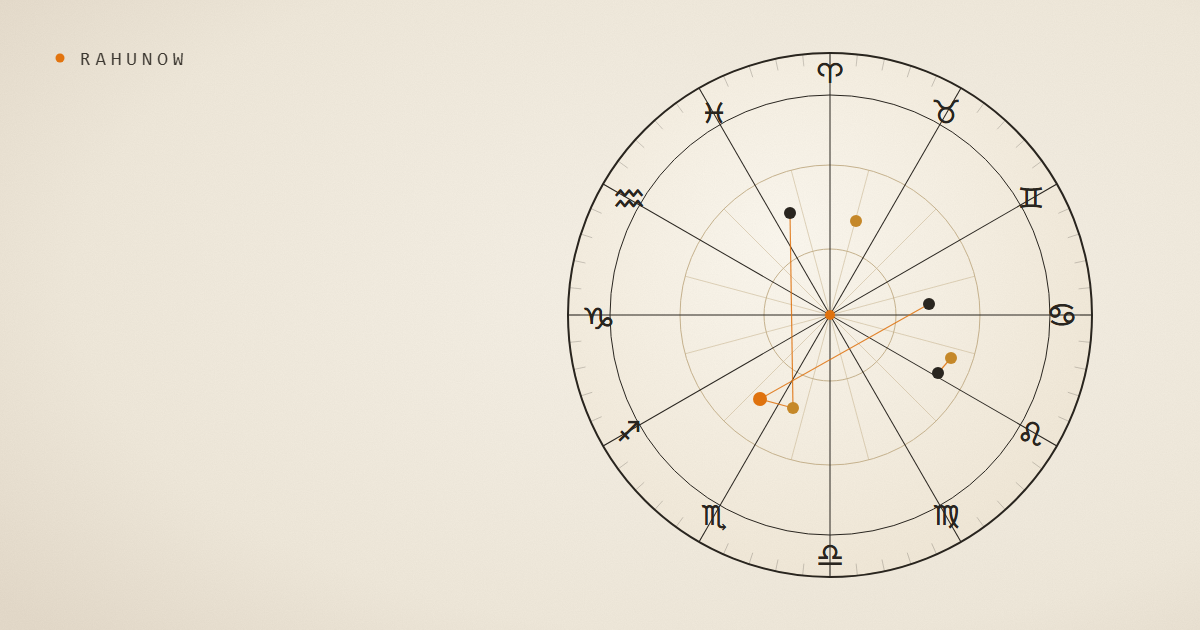
A Vedic birth chart — the kundali — is often treated like a sealed envelope containing your fate. It is something far more useful: a precise astronomical snapshot of the sky from the exact place and moment you were born. Every element in it is a real measurement, not a metaphor. Once you know what the pieces are, the chart stops being mysterious and starts being readable. Here is the five-minute tour.
The lagna: the chart’s anchor point
The lagna, or ascendant, is the zodiac sign that was rising on the eastern horizon at the moment of your birth. Because the Earth rotates once a day, all twelve signs rise over any horizon every 24 hours — so the lagna changes roughly every two hours, sometimes faster.
The lagna matters because it anchors everything else. The rising sign becomes your first house, and the remaining eleven houses follow in order from there. Two people born on the same day, with nearly identical planetary positions but a few hours apart, get genuinely different charts — every planet lands in a different house. In Jyotish — the Sanskrit name for Vedic astrology, literally “the science of light” — the lagna describes the self: the body, the temperament, and the lens through which the rest of the chart expresses itself.
The nine grahas
Jyotish tracks nine grahas. The word is usually translated “planet,” but it literally means “that which grasps” — an influence that takes hold. Seven are visible bodies; two are calculated points:
- Surya (Sun) — vitality, authority, the father, your sense of purpose.
- Chandra (Moon) — mind and emotion, the mother, your inner weather. In Jyotish the Moon is at least as important as the Sun.
- Mangala (Mars) — energy, courage, conflict, drive.
- Budha (Mercury) — speech, intellect, commerce, analysis.
- Guru (Jupiter) — wisdom, expansion, teachers, children, grace.
- Shukra (Venus) — relationships, beauty, pleasure, the arts.
- Shani (Saturn) — discipline, time, limits, labour, endurance.
- Rahu — the Moon’s north node: ambition, obsession, the unconventional.
- Ketu — the south node: detachment, insight, past mastery, release.
Rahu and Ketu are not physical bodies. They are the two points where the Moon’s orbit crosses the Sun’s apparent path — the points where eclipses occur. Jyotish treats them as full grahas, and much of the system’s distinctive flavour comes from how seriously it takes them.
The twelve houses
If the grahas are the actors, the twelve bhavas — houses — are the stages. Each governs a territory of life, counted from your lagna:
- 1st — body, self, overall direction
- 2nd — wealth, speech, family of origin
- 3rd — courage, effort, siblings, skills
- 4th — home, mother, property, inner contentment
- 5th — creativity, children, learning, romance
- 6th — work, service, health challenges, rivals
- 7th — marriage, partnership, the public
- 8th — transformation, longevity, shared resources, research
- 9th — dharma, fortune, father, teachers, long journeys
- 10th — career, status, visible achievement
- 11th — gains, income, networks, aspirations
- 12th — expenditure, sleep, foreign lands, retreat, liberation
A graha’s meaning is always read through its house. Saturn in the 10th is a very different conversation from Saturn in the 4th, even in the same sign.
Nakshatras: the 27 lunar mansions
Beneath the twelve signs runs an older, finer grid: the 27 nakshatras, each spanning 13°20′ of the zodiac. The Moon moves through roughly one nakshatra per day, and the one it occupied at your birth — your janma nakshatra — is among the most personal data points in the chart.
Nakshatras give Jyotish its texture. Two people with the Moon in the same sign can have quite different emotional signatures because their Moons sit in different nakshatras. Your janma nakshatra also sets the starting point of the Vimshottari dasha system — the planetary timeline Vedic astrology is famous for — and underlies traditional practices like naming syllables and compatibility matching.
Why exact birth time matters
Everything above is computed from three inputs: date, place, and time. The first two are usually solid. The third is where charts go wrong.
The lagna shifts sign every two hours on average — and near a boundary, a few minutes is enough to move it. When the lagna moves, every planet changes house. The Moon, meanwhile, moves about 13 degrees a day, so a birth time that is off by an hour can shift your janma nakshatra and slide your entire dasha timeline by months or even years.
Practical advice: use the time on the hospital record, not family memory rounded to the nearest half hour. If only an approximate time exists, a chart is still useful — the Moon sign, most planetary positions, and the broad dasha sequence survive small errors — but treat lagna-dependent details with appropriate humility. Astrologers call the process of refining an uncertain birth time rectification, and it always starts from the best record you have.
See it for yourself
Reading about houses is one thing; seeing your own Saturn sitting in one of them is another. Generate your chart and walk through it with this tour in hand:
- Your Chart — calculate your lagna, grahas, houses, and nakshatras from your birth details.
- Life Reading — a deeper guided reading that ties the pieces together, including your dasha timeline.
Five minutes to learn the map. The territory takes a little longer.