Lagna Explained: Why Your Ascendant Anchors the Chart
The lagna, or ascendant, is the sign rising on the eastern horizon at your birth. Here is why Vedic astrology treats it as the anchor of the whole chart, in plain language.
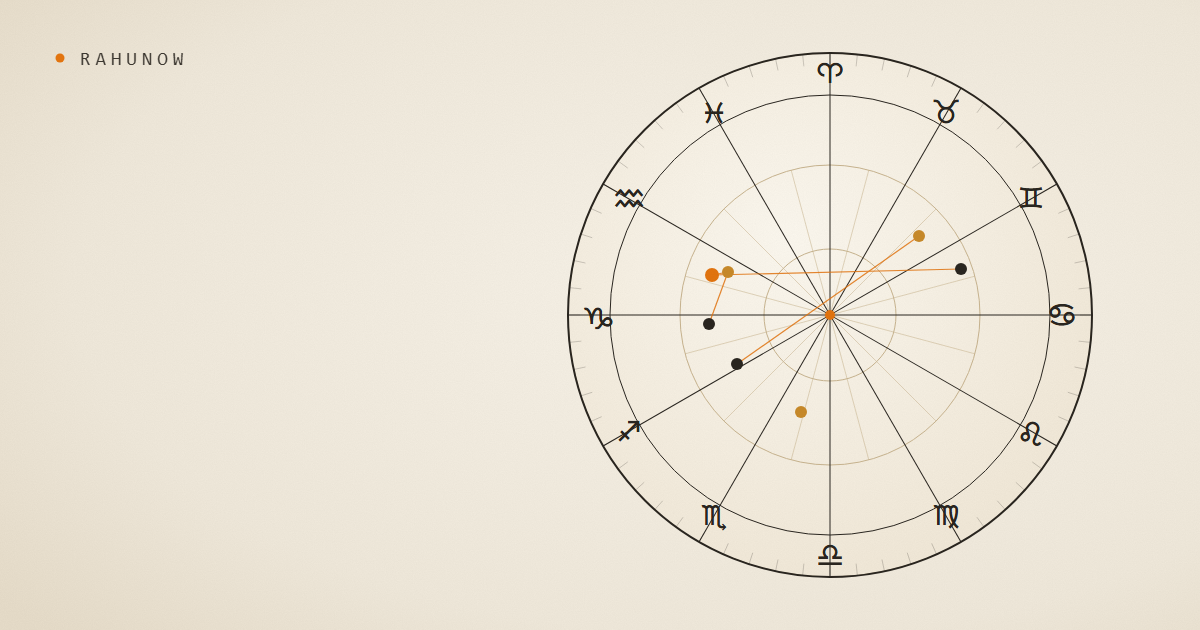
The lagna, or ascendant, is the sign of the zodiac that was rising on the eastern horizon at the exact moment and place of your birth. In Jyotish (Vedic astrology) it is the single most important point in the chart, more important for most purposes than the Sun sign that Western astrology leads with. The lagna anchors everything: it becomes the first house, and it fixes where every other house and planet sits. Get the lagna wrong, and the whole reading collapses.
This is why Vedic astrologers ask so insistently for an accurate birth time. A difference of a few minutes can change the rising sign and shift the entire framework of the chart.
What the lagna actually is
The earth turns once a day, so the entire zodiac appears to rise over the eastern horizon across roughly twenty-four hours. Each of the twelve signs takes about two hours to rise. The sign on the horizon at your birth moment is your lagna; the precise degree of it is the lagna point. This is a fact of astronomy, not interpretation, which is part of why the lagna is treated as the chart's backbone.
Because it depends on the time and place of birth, the lagna is intensely personal. Two babies born on the same day but a few hours apart share almost identical planetary positions yet can have entirely different rising signs, and therefore very different charts.
Why it anchors the houses

A Vedic chart is read through twelve bhavas, or houses, each governing an area of life: self, wealth, siblings, home, children, health, partnership, and so on. The lagna becomes the first house, the house of the self, body and overall direction. From there the houses follow in order around the chart.
This is the crucial point. The same planet, say Saturn in Libra, is a tenth-house career influence for one person and a third-house effort-and-courage influence for another, purely because their lagnas differ. The planets do not change; the frame the lagna sets does. Without the right ascendant, you cannot say which house any planet falls in, and house placement is most of what prediction rests on.
You can see this for yourself by casting your free Vedic birth chart, where the rising sign is marked as the first house and the rest of the chart is built outward from it.
Lagna, Moon and Sun: three lenses
Jyotish does not rely on the lagna alone. A careful reading uses three reference points:
- The lagna, for the body, temperament and the practical shape of life.
- The Moon sign, or Janma Rashi, for the mind, emotions and inner experience. Many transit predictions are read from here.
- The Sun sign, for the soul, vitality and the father, though it carries less weight in Vedic practice than in Western.
Reading from all three, the astrologer cross-checks a theme. If wealth shows up as strong from both the lagna and the Moon, the conclusion is more reliable than from one lens alone. A good chart reading triangulates rather than leaning on a single sign.
The lagna lord
Each sign has a ruling planet, and the planet that rules your rising sign is the lagna lord, or lagnesha. It is treated as a kind of significator of you, the self. Where the lagna lord sits, which house it occupies, and how strong or afflicted it is, say a great deal about the overall thrust of the life.
- A well-placed, strong lagna lord supports health, direction and resilience.
- A weak or afflicted lagna lord can show a life that struggles to find its footing, regardless of other strengths.
Tracing the lagna lord is one of the first things a Vedic astrologer does, and it is a good habit for any student.
Why the ascendant beats the Sun sign for character
Newspaper and app horoscopes are written for the Sun sign because it needs only your birth date, not your time. That convenience comes at a cost: a Sun-sign reading is the same for everyone born across an entire month, which is why it so often feels generic. The lagna is the opposite. It changes every two hours, so it captures the part of you that is genuinely yours rather than shared with millions.
This is why two people with the same Sun sign can be so different in temperament, build and the practical shape of their lives. Their rising signs, and therefore their whole house frameworks, differ. When a Vedic reading feels uncannily specific where a Western Sun-sign one felt vague, the accurate lagna is usually the reason. It is also why a careful astrologer will sometimes rectify a birth time, adjusting it slightly using known life events, when the recorded time is uncertain and the lagna is in doubt.
Putting it to use

If you are new to your own chart, start with the lagna and build outward:
- Confirm your birth time as precisely as you can, since the lagna depends on it.
- Identify your rising sign and its lord, and note which house the lord occupies.
- Read your chart from the lagna, the Moon and the Sun together, not from one alone.
For a structured walk through what your rising sign sets in motion across health, work and relationships, the guided life reading reads the chart from the lagna and ties it to your running dasha, the planetary period that drives timing.
The takeaway
The lagna is the sign rising at your birth, and it is the anchor of the entire Vedic chart. It fixes the houses, decides which house every planet falls in, and gives you the lagna lord as a significator of the self. Pair it with the Moon and Sun for a balanced reading, insist on an accurate birth time, and you have the foundation that everything else in Jyotish is built upon.
Frequently asked questions
What is the lagna in Vedic astrology?
The lagna, or ascendant, is the sign of the zodiac rising on the eastern horizon at the exact time and place of your birth. It becomes the first house of your chart and anchors the position of every other house and planet.
What is the difference between lagna and Moon sign?
The lagna is the rising sign and governs the body, temperament and practical shape of life. The Moon sign, or Janma Rashi, is the sign the Moon occupied at birth and governs the mind and emotions. Vedic astrology reads from both, along with the Sun sign.
Why does birth time matter so much for the lagna?
Each sign takes about two hours to rise over the horizon, so the rising sign changes through the day. A difference of a few minutes can shift the lagna to the next sign and change which house every planet falls in, which is why an accurate birth time is essential.
What is the lagna lord?
The lagna lord, or lagnesha, is the planet that rules your rising sign. It is treated as a significator of the self. Its house placement, strength and condition say a great deal about the overall direction and resilience of the life.
Sources
Related reads
Keep exploring
Researched and written by SuperPandit’s AI, grounded in our own astronomical engine. Spotted something off? Tell us.