Vimshottari Dasha: Why Vedic Astrology Has a Timeline
Vedic astrology doesn’t just describe your chart — it schedules it. How the 120-year Vimshottari cycle works, what mahadashas and antardashas are, and what “your Saturn period” actually means in practice.
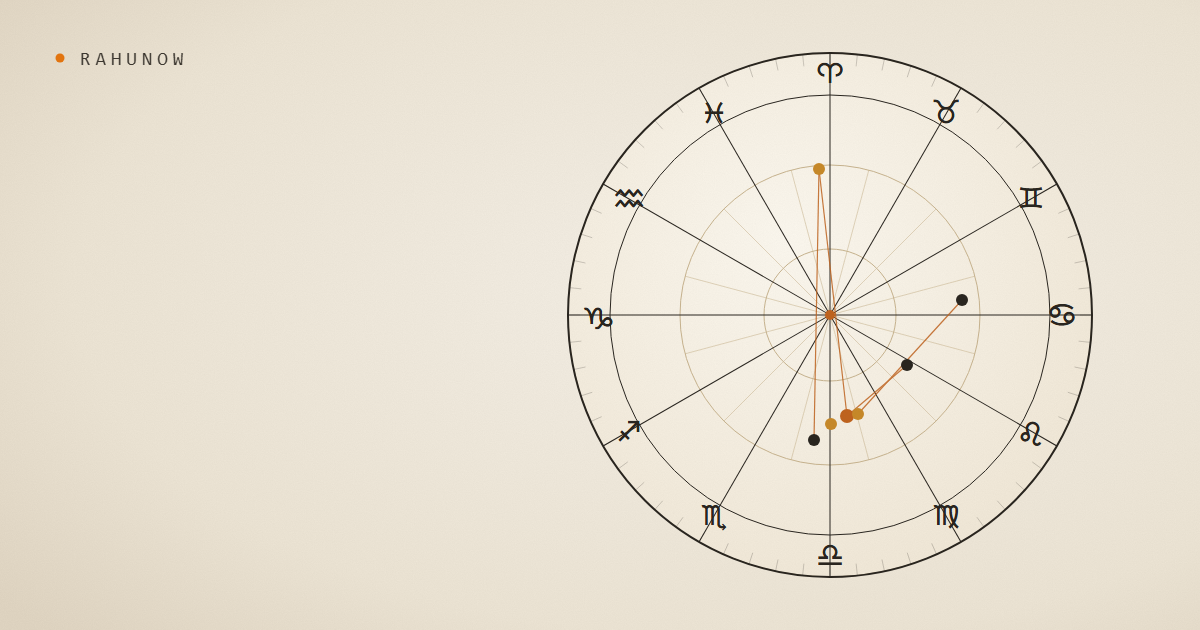
Ask a Western astrologer about your chart and you will mostly hear about what: what your Sun sign means, what your Venus placement says about love. Ask a Jyotishi and the conversation quickly turns to when. Vedic astrology carries something most other systems lack: a built-in timeline that divides a whole life into planetary chapters. It is called Vimshottari dasha, and it is the reason a Vedic reading can say not just “Saturn matters for you” but “Saturn’s chapter runs from 2031 to 2050.”
One hundred and twenty years, nine chapters
Vimshottari means “one hundred and twenty.” The system assigns each of the nine grahas — the planets of Jyotish, including the lunar nodes Rahu and Ketu — a fixed span of years, and the spans add up to a 120-year cycle. The order and the lengths never change:
| Order | Graha | Mahadasha length |
|---|---|---|
| 1 | Ketu | 7 years |
| 2 | Venus (Shukra) | 20 years |
| 3 | Sun (Surya) | 6 years |
| 4 | Moon (Chandra) | 10 years |
| 5 | Mars (Mangala) | 7 years |
| 6 | Rahu | 18 years |
| 7 | Jupiter (Guru) | 16 years |
| 8 | Saturn (Shani) | 19 years |
| 9 | Mercury (Budha) | 17 years |
Each of these long chapters is a mahadasha — a “great period.” Nobody starts the cycle at the beginning. Your entry point is set by the Moon: the nakshatra (one of the 27 lunar mansions, each ruled by one of the nine grahas) that the Moon occupied at your birth determines your first mahadasha, and how far the Moon had travelled through that nakshatra determines how much of the period was already spent. A child born with the Moon two-thirds of the way through a Venus-ruled nakshatra begins life with roughly the final third of a Venus mahadasha, then moves on to Sun, Moon, Mars, and so on, in the fixed order above.
This is also why dasha calculations are sensitive to birth time. The Moon moves about 13 degrees per day; an error of an hour can shift the opening balance by months, and every later date in the timeline inherits the error.

Mahadasha and antardasha: chapters and scenes
A 19-year Saturn chapter is too long a unit to say anything specific, so each mahadasha is subdivided into nine antardashas — sub-periods — that cycle through all nine grahas in the same fixed order, beginning with the mahadasha lord itself. The lengths are proportional: each antardasha takes the same share of the mahadasha that its lord takes of the full 120 years. Saturn’s antardasha inside Saturn’s own mahadasha runs about three years; the Sun’s antardasha inside Saturn runs just under a year.
At any moment of your life, then, you sit at a nested address — a mahadasha and an antardasha, written like “Saturn–Mercury.” The mahadasha sets the chapter’s theme; the antardasha colours the current scene. Traditional practice subdivides further still — pratyantardashas and below — but the maha–antar pair carries most of the practical weight.
What “your Saturn period” actually means
Here is where pop astrology goes wrong. A mahadasha is not a generic script — Saturn period equals hardship, Venus period equals romance. A mahadasha moves one graha to the foreground: for those years, the agenda of that planet as it stands in your particular chart becomes the running storyline.
That qualifier does all the work. Suppose Saturn in your chart rules the 10th house of career and sits strongly placed: its 19-year mahadasha tends to read as the long, unglamorous, ultimately solid building of a professional life — responsibility accumulating, reputations that stick. Suppose instead Saturn rules difficult houses and sits weakly: the same 19 years foreground delay and friction and ask for patience. Same planet, same period name, a different contract — because the contract was written in the birth chart.
The checklist a Jyotishi runs for any period is short:
- Which houses does the dasha lord rule, and which house does it occupy?
- How strong is it — sign placement, the aspects it receives, its conjunctions?
- What does the current antardasha lord add or subtract?
Answer those three and “your Saturn period” turns from a horoscope cliché into a specific, checkable statement about your own chart.

A rhythm, not a verdict
The dasha system’s real gift is rhythm. It says a chart is not experienced all at once: different placements switch on in different decades, and some things are not late — they are scheduled. The student who blooms at 32 when a Mercury mahadasha begins, the career that consolidates across a long Saturn period, the inward turn of a Ketu chapter: Jyotish reads these as a timetable doing what timetables do.
That makes the practical use of dashas closer to scheduling than sentencing. Knowing a Saturn mahadasha has begun does not tell you to brace for doom; it tells you which planet’s agenda to take seriously and what kind of effort the coming years are likely to reward. Find your Moon’s nakshatra and the whole 120-year sequence unrolls from there — any Vedic chart tool computes it in seconds. The skill, as ever, is in reading the chapters honestly.