The Nine Planets (Navagraha) of Vedic Astrology
The Navagraha are the nine grahas Vedic astrology reads: the Sun and Moon, five visible planets, and the lunar nodes Rahu and Ketu. Here is what each one signifies and how they rank.
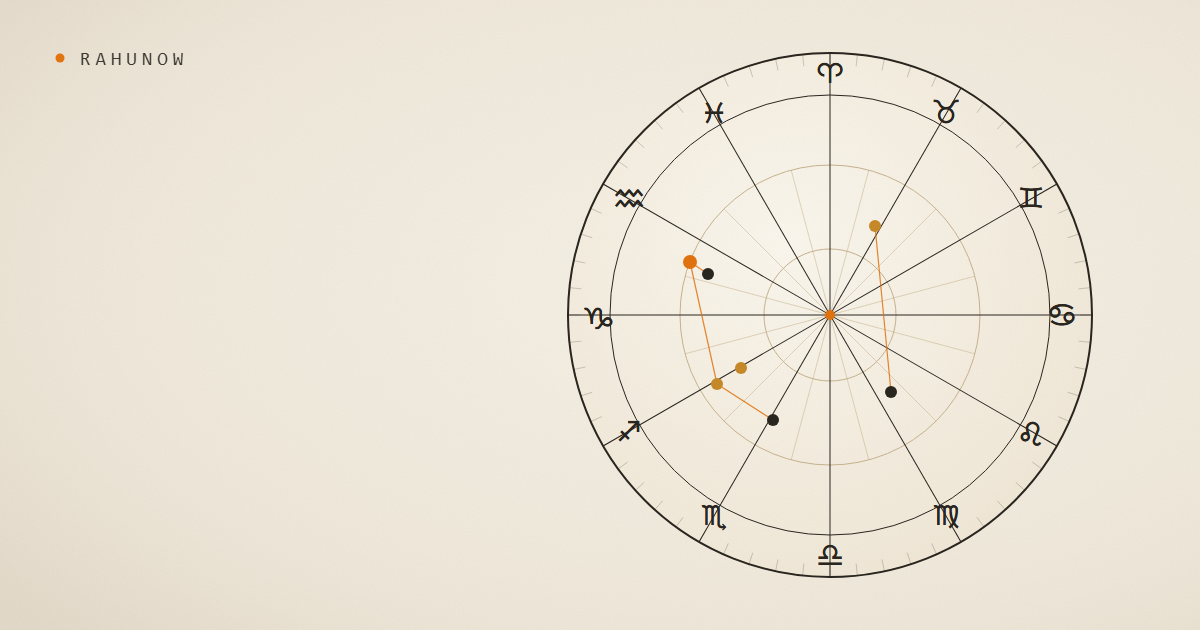
The Navagraha, literally the nine grahas (the Sanskrit word for planet, more precisely a body that seizes or influences), are the nine celestial factors that Vedic astrology reads in a chart. They are the Sun (Surya), the Moon (Chandra), Mars (Mangal), Mercury (Budha), Jupiter (Guru), Venus (Shukra), Saturn (Shani), and the two lunar nodes, Rahu and Ketu. Understanding the Navagraha is foundational, because every prediction in Jyotish (Vedic astrology) traces back to what these nine are doing, in which sign and in which house.
Two things distinguish the Vedic list from the modern astronomical one. First, the Sun and Moon are counted as grahas, not as a star and a satellite. Second, the outer planets Uranus, Neptune and Pluto are not part of the classical scheme, while Rahu and Ketu, which are not physical bodies at all but the two points where the Moon's path crosses the Sun's, are. That gives nine influences, not eleven.
The luminaries: Sun and Moon
- Surya (Sun): the soul, vitality, the father, authority and the sense of self. A strong Sun gives confidence and a clear centre; a weak one can show as low vitality or issues with authority.
- Chandra (Moon): the mind, emotions, the mother and the general well-being of the psyche. In Jyotish the Moon is so important that the Janma rashi (Moon sign) is often read before the ascendant.
The Sun and Moon are the natural rulers of the chart's inner life. Everything else colours how that inner life meets the world.
The five star-planets
- Mangal (Mars): energy, courage, drive, conflict, land and brothers. Mars gives the capacity to act and to defend, and when afflicted, the tendency to anger or accident.
- Budha (Mercury): intellect, speech, commerce, analysis and communication. The planet of the rational mind and of trade.
- Guru (Jupiter): wisdom, expansion, teachers, children, wealth and dharma. The great benefic, whose touch tends to protect and enlarge whatever it aspects.
- Shukra (Venus): love, beauty, relationships, comfort, art and vehicles. The other benefic, governing pleasure and partnership.
- Shani (Saturn): discipline, delay, hard work, longevity, sorrow and time itself. The great teacher whose lessons come through restriction and patience.
Rahu and Ketu: the shadow grahas
Rahu and Ketu are the chhaya grahas, the shadow planets. They are the north and south nodes of the Moon, always exactly opposite each other, and they always move in retrograde. Because they are points rather than bodies, they act through the houses and planets they touch rather than through light of their own.
- Rahu (north node): obsession, ambition, foreign things, technology, sudden rise and illusion. It amplifies and distorts, pulling the mind outward toward what it does not yet have.
- Ketu (south node): detachment, spirituality, past mastery, sudden loss and liberation. It strips away and turns the attention inward.
The nodal axis is one of the most closely watched features of a chart, and its transits, such as the current Rahu-Ketu placement, reshape collective as well as personal themes.
Benefics, malefics and rank
The grahas are broadly sorted into natural benefics (Jupiter, Venus, a strong Moon and well-placed Mercury) and natural malefics (Saturn, Mars, the Sun in some contexts, and Rahu and Ketu). This is a starting point, not a verdict: a malefic can protect strongly when it rules the right houses, and a benefic can harm when it rules difficult ones. Each graha also owns particular signs, is exalted in one and debilitated in another, and has a set of drishtis (aspects) through which it influences other parts of the chart. None of this predetermines a fixed fate; it describes tendencies that unfold through the dashas (planetary periods).
Reading the nine in your own chart
The way to make the Navagraha real is to see where your own nine sit. Cast a free Vedic birth-chart calculator and note each graha's sign and house; that tells you which departments of life each planet is running. From there the guided life reading interprets their strengths, aspects and combinations, and if you want a person to walk you through your particular placements, a one-on-one consultation can go deeper than any general guide.
Everything in Jyotish is built on these nine. Learn what each graha signifies, and the rest of the system, the houses, the yogas, the dashas, becomes a set of variations on a theme you already know.
Frequently asked questions
What are the Navagraha?
The Navagraha are the nine planets of Vedic astrology: the Sun, Moon, Mars, Mercury, Jupiter, Venus, Saturn, and the two lunar nodes, Rahu and Ketu. Every reading in Jyotish is based on what these nine are doing in the chart.
Why are Rahu and Ketu called shadow planets?
Rahu and Ketu are not physical bodies but the two points where the Moon's orbit crosses the Sun's apparent path. Because they have no light of their own, they are called chhaya, or shadow, grahas, and they act through the houses and planets they contact.
Why aren't Uranus, Neptune and Pluto included?
The classical Vedic system predates the discovery of the outer planets and reads only the bodies visible to the naked eye, plus the two lunar nodes. This gives the fixed set of nine grahas rather than the modern astronomical count.
Which planets are benefic and which are malefic?
Jupiter and Venus are natural benefics, with a strong Moon and well-placed Mercury; Saturn, Mars and the nodes are natural malefics. However, a planet's actual effect depends on the houses it rules and its placement, so the labels are only a starting point.
Sources
Related reads
Keep exploring
Researched and written by SuperPandit’s AI, grounded in our own astronomical engine. Spotted something off? Tell us.