Vedic vs Western Astrology: Why the Zodiacs Disagree
Many people find their Vedic Sun sign is one sign earlier than their Western one. The reason is the ayanamsa, the gap between the sidereal and tropical zodiacs. A clear explainer.
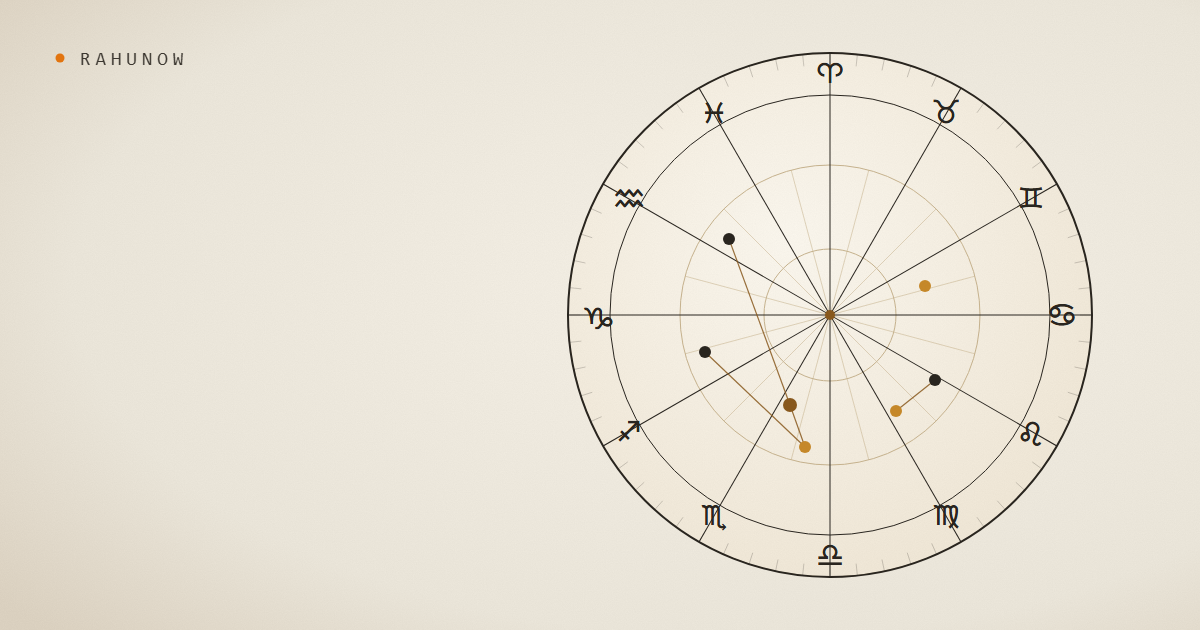
Vedic vs Western astrology is the first puzzle most newcomers hit: someone who has always been a Western Aries opens a Vedic chart and finds the Sun in Pisces instead. Nothing is broken. The two systems measure the sky from different starting points, and the gap between them, called the ayanamsa, is the single fact that explains almost every difference you will notice. Understanding it removes most of the confusion in one step.
Two zodiacs, two starting lines
A zodiac is just a way of dividing the band of sky the Sun travels into twelve equal signs of 30 degrees each. The question is where to put zero degrees of Aries, the starting line.
- Western astrology uses the tropical zodiac. It fixes zero Aries to the spring equinox, the moment the Sun crosses the celestial equator each year. It is anchored to the seasons.
- Vedic astrology (Jyotish) uses the sidereal zodiac. It fixes the signs to the actual background stars, the constellations. It is anchored to the fixed stars.
When these systems were first formalised, the two starting points roughly coincided. They no longer do, and the reason is a slow wobble of the Earth itself.
The precession of the equinoxes

The Earth's axis does not point in a perfectly fixed direction. It traces a slow circle, like a spinning top winding down, taking about 25,800 years to complete one turn. This wobble is called the precession of the equinoxes. Because the equinox point drifts backward against the stars by roughly one degree every seventy-two years, the tropical zero-Aries (tied to the equinox) slowly separates from the sidereal zero-Aries (tied to the stars).
That accumulated gap is the ayanamsa. In the present era it is roughly 24 degrees. The most widely used value in Indian astrology is the Lahiri ayanamsa, named after the astronomer N. C. Lahiri and adopted as the official Indian standard.
Why your sign may shift by one
Roughly 24 degrees is close to a full sign of 30 degrees. So when you convert a tropical chart to a sidereal one, most planets, including the Sun, move back by about that much. If your Western Sun sat in the early part of a sign, subtracting the ayanamsa often drops it into the previous sign. This is why so many people are, say, Western Gemini but Vedic Taurus. Neither is wrong; they are answers to two different questions. The tropical answer asks where the Sun was relative to the season; the sidereal answer asks where it was relative to the stars.
You can see your own sidereal placements, including your Moon sign and your nakshatra (lunar mansion), with the free Vedic birth-chart calculator, which uses the Lahiri ayanamsa.
More than a different Sun sign

The zodiac offset is the headline, but Vedic and Western astrology diverge in deeper ways too.
- The Moon and nakshatras: Jyotish leans heavily on the Moon sign and the twenty-seven nakshatras, where Western practice centres the Sun sign.
- Timing systems: Vedic astrology uses the Vimshottari dasha, a planetary-period timeline with no close Western equivalent.
- The outer planets: classical Jyotish works with the seven visible grahas plus the lunar nodes Rahu and Ketu, and does not rely on Uranus, Neptune and Pluto.
- Divisional charts: Jyotish subdivides the chart into vargas, such as the navamsa, for finer reading.
This is why a Vedic reading often feels different in kind, not just in sign labels. To see how the sidereal chart, the nakshatras and the dasha timeline come together in practice, a guided life reading with the Vimshottari timeline walks through them on your own birth data.
Which one is correct
Neither system is correct in an absolute sense, because they are measuring against different reference frames on purpose. The honest answer is that they are internally consistent traditions that answer different questions, and many practitioners value both. For anyone working within Jyotish, the practical takeaway is simple: use the sidereal chart, expect your sign to differ from the Western one by about a sign, and read the Moon and nakshatra as carefully as the Sun. Once the ayanamsa makes sense, the rest of Vedic astrology stops feeling contradictory and starts feeling coherent.
Frequently asked questions
Why is my Vedic sign different from my Western sign?
Because the two systems use different zodiacs. Western astrology ties the signs to the seasons (tropical), while Vedic astrology ties them to the fixed stars (sidereal). The roughly 24-degree gap between them, the ayanamsa, often shifts placements back by about one sign.
What is the ayanamsa?
The ayanamsa is the angular difference between the tropical and sidereal zodiacs, caused by the slow precession of the equinoxes. It is currently about 24 degrees. The Lahiri ayanamsa is the most widely used value in Indian astrology and the official Indian standard.
Which is more accurate, Vedic or Western astrology?
Neither is more accurate in an absolute sense. They measure against different reference frames on purpose, the stars versus the seasons, and each is internally consistent. They answer different questions, and many practitioners draw value from both traditions.
Does Vedic astrology use the same planets as Western?
Mostly, but with differences. Jyotish works with the seven visible grahas plus the lunar nodes Rahu and Ketu, and traditionally does not rely on Uranus, Neptune and Pluto. It also emphasises the Moon, the twenty-seven nakshatras and the Vimshottari dasha timeline.
Sources
Related reads
Keep exploring
Researched and written by SuperPandit’s AI, grounded in our own astronomical engine. Spotted something off? Tell us.