The Navamsa (D9) Chart: Marriage, Dharma and Strength
The Navamsa or D9 is the most important divisional chart in Jyotish, read for marriage, dharma and the true strength of a planet. Here is what it is and how it is used.
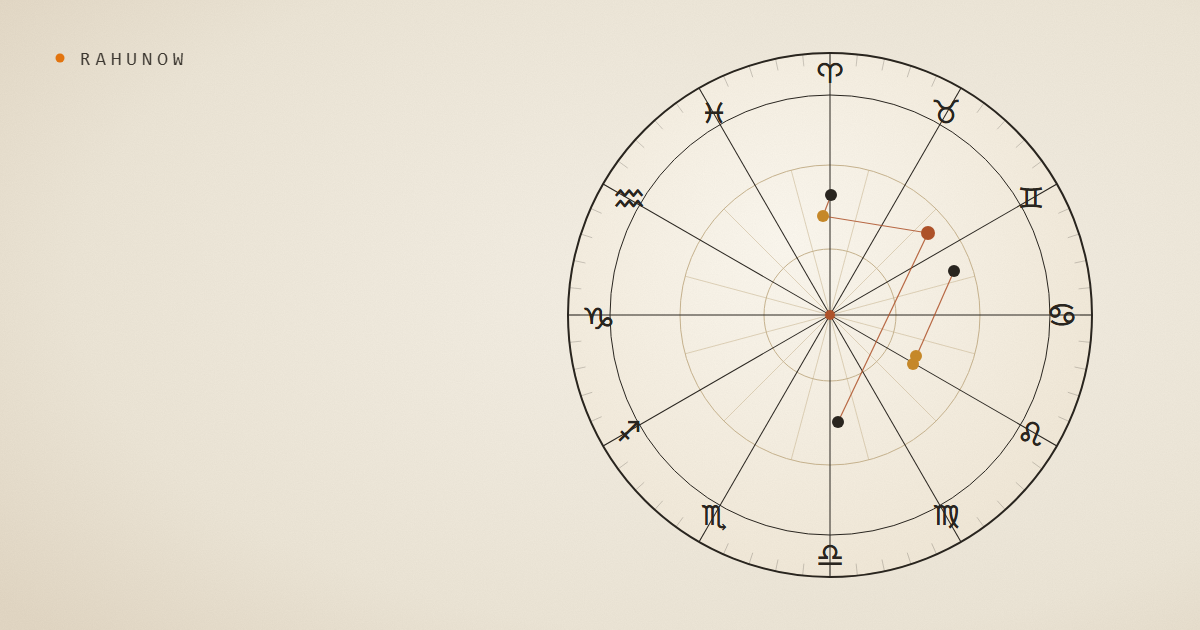
The Navamsa, written D9, is the most important divisional chart in Jyotish (Vedic astrology) after the birth chart itself. Where the main chart, the Rashi or D1, shows the broad outline of life, the Navamsa magnifies a planet's real strength and is read above all for marriage, partnership and dharma, one's deeper purpose and right path. A seasoned Vedic astrologer rarely judges a chart without looking at the D9 alongside it.
The name explains the method. Navamsa means one-ninth: each sign of thirty degrees is divided into nine equal parts of three degrees and twenty minutes each, and every part is mapped to a sign. The resulting grid is the Navamsa chart.
What a divisional chart is
A divisional chart, or varga, takes the birth chart and slices it more finely to study one department of life in depth. There are sixteen classical vargas, each tied to a theme: the D10 for career, the D7 for children, the D4 for property, and so on. The Navamsa is the ninth division, and it carries unusual weight because it speaks to two of the most consequential areas of life, marriage and dharma, and because it acts as a strength test for every planet.
Think of the D1 as the wide photograph and the D9 as a close-up of the most important corner of it. Both are the same chart seen at different magnifications.
Why the Navamsa is read for marriage

By long convention, the Navamsa is the primary chart for understanding marriage and the marriage partner. The seventh house of the D1 shows partnership in outline; the D9 fills in the texture, the quality of married life, the nature of the spouse, and how a partnership matures over time.
This is also why the Navamsa is sometimes called the chart of the second half of life. Many astrologers read the D1 as dominant in early life and the D9 as increasingly expressive after marriage and into middle age. A planet that looks ordinary in the birth chart but excellent in the Navamsa is said to deliver its best later, once life has settled.
If you want to look at your own seventh house and the partnership it describes, you can cast your free Vedic birth chart first; the D9 is then derived from those same planetary degrees.
The strength test: vargottama and beyond
The Navamsa's other great use is as a measure of a planet's true strength. The key terms are worth knowing:
- Vargottama: when a planet occupies the same sign in both the D1 and the D9. This is a mark of stability and strength; such a planet delivers its promise reliably.
- A planet exalted or in its own sign in the Navamsa gains strength even if it was weak in the birth chart, and can outperform its D1 appearance.
- A planet debilitated in the Navamsa loses lustre even if the birth chart flattered it.
This is why a quick glance at the D1 alone can mislead. A planet that looks powerful in the Rashi chart but collapses in the Navamsa often fails to deliver, and a modest-looking planet that shines in the D9 quietly over-performs. The two charts are read together, never in isolation.
Dharma, not just marriage
The Navamsa is so strongly tied to marriage in popular practice that its other meaning is often forgotten. Classically, the ninth division corresponds to the ninth house theme of dharma, one's deeper purpose, ethics, fortune and path. The D9 therefore speaks to whether a person lives in line with their own nature, and to the inner strength that carries them through life, not only to the spouse they marry.
This is the thread that connects its two uses. Marriage, in the traditional view, is itself a dharmic institution, a vehicle for living one's purpose rather than merely a romantic arrangement. Reading the Navamsa for both partnership and path is not two separate jobs but one: it asks how solidly a person is rooted in their own truth, and partnership is the most testing arena in which that rootedness shows. A strong D9 describes someone whose commitments, to a person and to a way of living, tend to hold.
How to use it sensibly

For a beginner, the Navamsa is best approached with a few honest limits in mind:
- It refines and confirms the birth chart; it does not replace it. Read the D1 first, then test it against the D9.
- It is sensitive to birth time, even more than the main chart, because the three-degree-and-twenty-minute slices are narrow. A slightly wrong time can change Navamsa placements, so an accurate birth time is essential.
- It is a tool for depth, not for fortune-telling. The D9 describes the quality and maturing of partnership and purpose; it does not name dates. Timing still comes from the dasha and transits.
For questions of marriage and compatibility, the Navamsa is one input among several, and it is best read by an experienced astrologer who can weigh it against the seventh house, the karakas and the running periods. If you want that kind of personal reading, a one-on-one consultation with an astrologer can interpret your D9 in context, and the guided life reading ties partnership themes to your Vimshottari dasha timeline.
The takeaway
The Navamsa, or D9, is the close-up chart of Jyotish: the ninth division read for marriage, dharma and, crucially, the true strength of every planet. Learn the idea of vargottama, treat the D9 as a partner to the birth chart rather than a substitute, insist on an accurate birth time, and you have access to the single most useful divisional chart in Vedic astrology.
Frequently asked questions
What is the Navamsa or D9 chart?
The Navamsa, or D9, is the most important divisional chart in Vedic astrology. It divides each sign into nine equal parts and maps them to signs, producing a chart read mainly for marriage, dharma and the true strength of each planet.
Why is the Navamsa used for marriage?
By convention the Navamsa is the primary chart for marriage and the marriage partner. The seventh house of the birth chart shows partnership in outline, while the D9 fills in the quality of married life, the nature of the spouse and how the partnership matures over time.
What does vargottama mean?
A planet is vargottama when it occupies the same sign in both the birth chart and the Navamsa. It is a mark of stability and strength, indicating that the planet delivers its results reliably and consistently.
Can the Navamsa be read without the birth chart?
No. The Navamsa refines and tests the birth chart rather than replacing it. Astrologers read the D1 first and then check it against the D9, since a planet's appearance can change markedly between the two charts.
Sources
Related reads
Keep exploring
Researched and written by SuperPandit’s AI, grounded in our own astronomical engine. Spotted something off? Tell us.